


The high school Bible study I lead is currently studying Philippians. As a teacher, it is encouraging to witness a hunger in their generation for studying the Holy Scriptures. Our normal routine is to study paragraph by paragraph. When studying Paul’s epistles, we are sure to capture the ‘big picture’ of what he’s trying to communicate. We then move verse-by-verse. Questions about what a particular phrase or word might convey arise. We’ll even sometimes paraphrase Paul’s language into modern ‘teenage’ vernacular. Yet, we take care to consider how Paul’s theology is directly correlated to the life and ministry of Jesus. And, of course, we want to ask how that particular Scripture shapes our own discipleship. Though this method moves at a slow pace, the depth of conversation has proven to be well worth it.
Recently, our Bible study focused on Philippians 2:1-11. This is the infamous ‘kenosis passage’ referring to how Jesus “emptied himself” for our sake. William Barclay’s work has long been a valuable resource for me. His colorful commentaries have filled the shelves of my dad’s library for as long as I can remember. Now I, too, have a shelf dedicated to his work. Barclay’s commentary on Philippians has proven useful during our current study. His section on Philippians 2:5-7 was especially impactful as our Bible study moved through the passage.
Philippians 2:5-7 reads, “Have this mind among yourselves, which is yours in Christ Jesus, who, though he was in the form of God, did not count equality with God a thing to be grasped, but emptied himself, by taking the form of a servant, being born in the likeness of men” (ESV). The question I was wrestling with was what do these “forms” of Jesus mean? Barclay writes:
“There are two Greek words for form, morphē and schēma. They must both be translated form, because there is no other English equivalent, but they do not mean the same thing. Morphē is the essential form which never alters; schēma is the outward form which changes from time to time and from circumstance to circumstance.”1
He goes on to give some examples to illustrate. He mentions how the morphē of a human is his humanity. All throughout a person’s life, his essence or nature is always as a human. Yet the schēma of a human can change. The human stages—infancy, adolescence, adulthood, and finally elderly years—represent the changing schēma of that human. Barclay then shifts from examples to the main idea of verse 6: “The word Paul uses for Jesus being in the form of God is morphē; that is to say, his unchangeable being is divine.”2
To say that Jesus “was in the form of God” is to say that Jesus is eternally God. Deity is Jesus’ eternal nature. He did not become God as if to say there was as a time when he wasn’t divine. Further, the divinity of Jesus forever remains divine. There is no shifting or change in Jesus’ divine nature. Conversely, there are elements of Jesus’ form that did change. His schēma was one that came to us as a helpless babe. He “increased in wisdom and in stature and in favor with God and man” (Luke 2:52 ESV). Though his schēma changed, his morphē never did.
Barclay is not alone in this interpretation. Another commentator came to my attention, that of Edwin Gifford. He affirms the same position that Barclay holds and, in some ways, develops it further. He writes:
“For the interpretation of ‘the form of God’ it is sufficient to say that (1) it includes the whole nature and essence of Deity, and is inseparable from them, since they could have no actual existence without it; and (2) that it does not include anything ‘accidental’ or separable, such as particular modes of manifestation, or conditions of glory and majesty, which may at one time be attached to the ‘form,’ at another separated from it.”3
The first point that Gifford makes here is that not only is Jesus fully God, but Jesus is existentially God. Put another way, there is no existence of Jesus without his divine nature. His second point highlights that Jesus’ divinity was not a conditional feature or addition.
To summarize Barclay and Gifford on verse 6:
When Paul says that Jesus is “in the form (morphē) of God,” he is saying that Jesus is in his very nature God;
This form is eternally true of Jesus—past, present, and future;
This form will not, and cannot, be changed.
If all of this is true, and I believe it is, then the rest of this passage will soon present a profound image of Christ.
Exactly how this all plays out is a mystery. But as with all theology, we don’t start with how. We start with who.
With this basis in mind, let’s turn the focus now to verse 7. Here we read the phrase, “he emptied himself, by taking the form of a servant.” Can you take a guess at which word Paul uses here for “form?” Once again, Paul uses morphē. The implications here are astounding, yet mysterious. What is true of Jesus’ form of God is also true of Jesus’ form of servant. Returning to our conclusions from verse 6, we can now say that Jesus is, in his very nature, a servant. This form is eternally true of Jesus—past, present, and future. This form will not, and cannot, be changed. Exactly how this all plays out is a mystery. But as with all theology, we don’t start with how. We start with who. Jesus is, in his nature, the God-Servant. As Gifford points out, the servant nature of Jesus is not a particular mode of manifestation that he can be separated from. A servant is who he is.
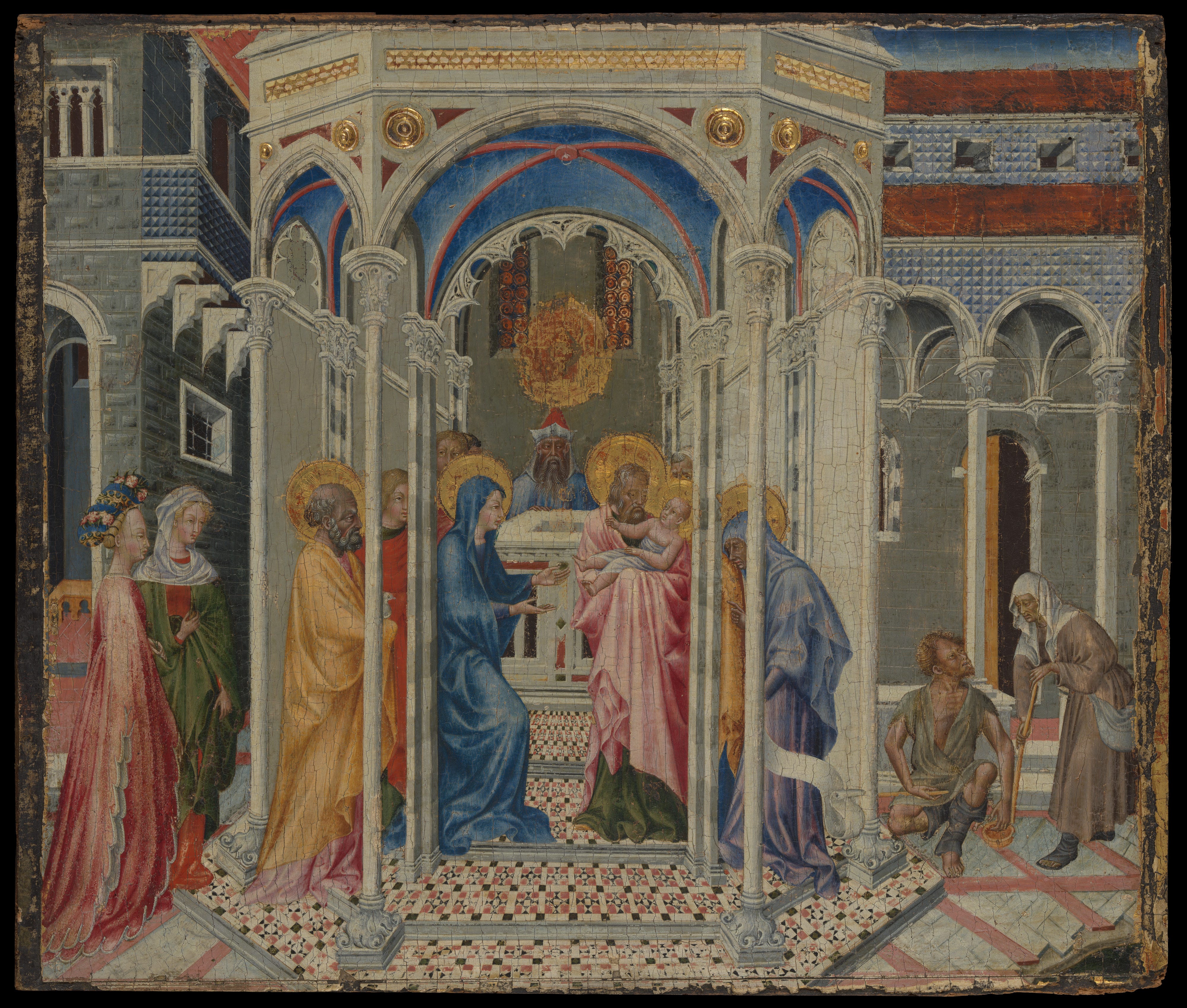
Today being the feast of The Presentation of Christ in the Temple brings this reality to a grand measure. The schēma of the babe is at the same time the morphē of the Servant-God. The infant who was presented by his parents is the same one “that at the name of Jesus every knee should bow, in heaven and on earth and under the earth, and every tongue confess that Jesus Christ is Lord, to the glory of God the Father” (Philippians 2:10-11 ESV). When Simeon laid eyes on that babe born a mere 40 days before and saw the face of God, the only appropriate reply was: “mine eyes have seen thy salvation” (Luke 2:30 RSV). Even as a babe, he is who he is.
Bennett Ellison is a pastoral associate at the Church of the Cross in Bluffton, SC. He is pursuing Holy Orders in the ACNA. Most of his work centers on sacramental theology and Christology. He has an M.Div. from Asbury Seminary and is currently completing an Anglican Studies certificate at Trinity Anglican Seminary.
Barclay, The Letters to the Philippians, Colossians, and Thessalonians, 35.
Barclay, The Letters to the Philippians, Colossians, and Thessalonians, 36.
Gifford, The Incarnation: A Study of Philippians II, 5-11, 35.
