


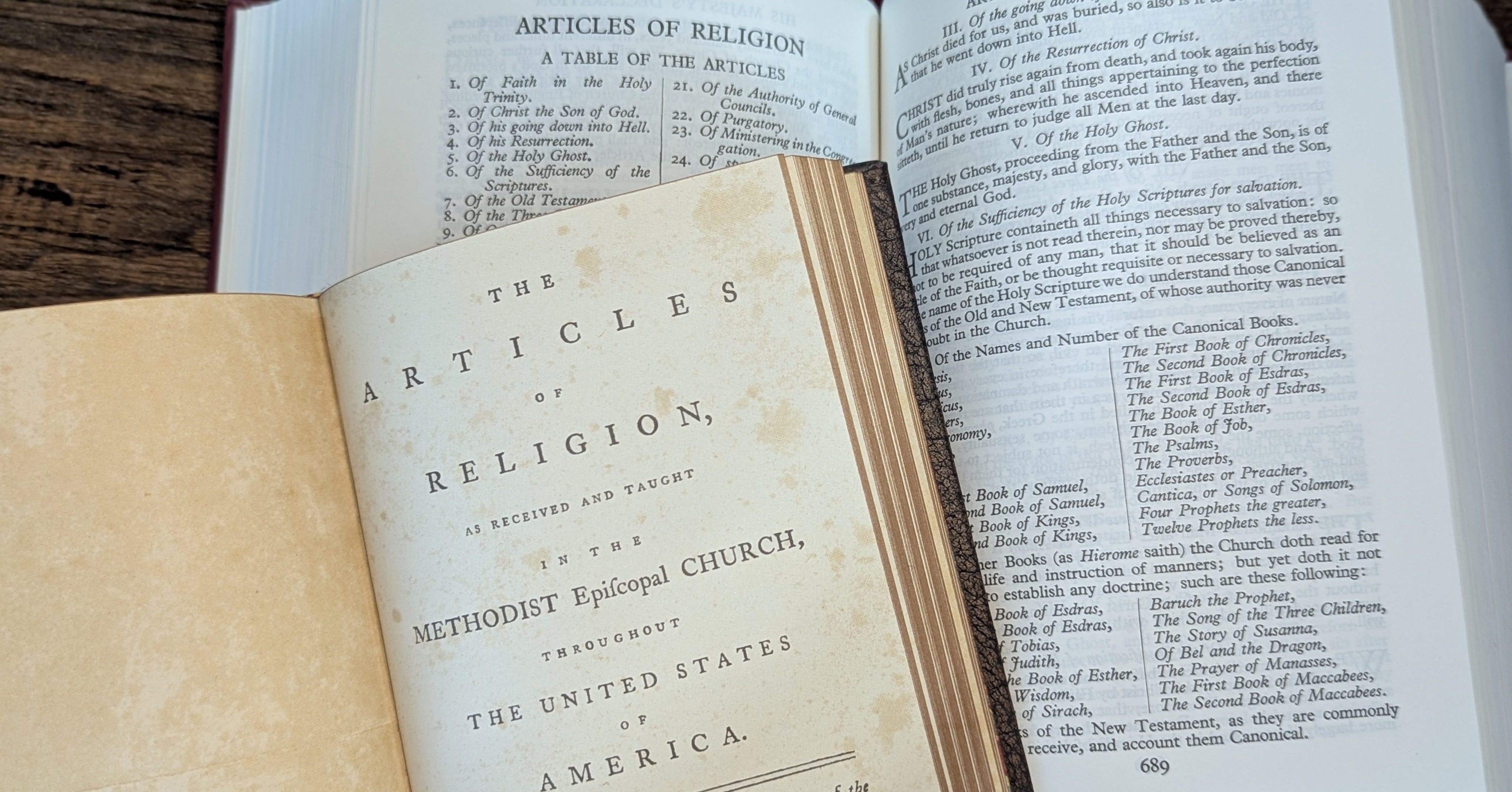
At the 2024 General Conference, the Global Methodist Church empowered the Discipleship, Doctrine, and Just Ministry Commission to “synthesize the content of the Articles of Religion and the Confession of Faith into a single document.”1 An exception was added to the Restrictive Rule to allow for this task.
On April 1, 2026, the Commission announced via a Facebook post it had completed a proposed synthesis document, the “Articles of Faith,” and would receive feedback on it for 20 days, after which a final version will be sent to the upcoming 2026 General Conference for proposed adoption. I have not seen an announcement make such large waves in the Wesleyan online world since the UMC split. I am not a Global Methodist, so I do not feel the need to wade into the controversy about the language of the proposed Articles of Faith.2 Instead, I invite you to join me in examining what the original Methodists and their faithful heirs believed about confessions generally and Articles of Religion specifically, offering a historical perspective on the current discussion grounded in the principle of reception.
The Wesley Family and the Articles of Religion
To begin examining the importance of confessional statements in the Wesleyan tradition, we must look before the foundation of Methodism. The issue of conformity to the Articles and the received faith of the Church of England was a central issue in the lives of the entire Wesley family for generations preceding the Methodist movement. John and Charles’ paternal great-grandfather, paternal grandfather, and maternal grandfather were, alongside many other nonconformist clergymen of their day, ejected from their ministry and parishes for refusing to conform to the doctrinal and liturgical standards of the Church of England.
John and Charles’ father, Samuel, and their mother, Susanna, were both raised nonconformists. They decided to independently study the faith and were convinced by the teachings of the Church of England. They joined with the English Church and broke from the dissent of their parents and grandparents (for Susanna, this was at the age of 12!). The lives of John and Charles are irrevocably shaped by their parents’ decision to conform to the Articles of Religion against continuing in the Puritan and nonconformist faith of their families.
John and Charles grew up intimately familiar with the controversies surrounding nonconformity. Samuel, who came into conformity in his 20s before marrying Susanna and later being ordained in the late 1680s, was writing tracts against nonconformists as early as 1693. For the rest of his life, he would be a learned advocate of the Highchurch party and English Arminianism. In many ways, John and Charles were following in their father’s footsteps.
As J.R. Watson summarizes, “…for the Wesley brothers, the subscription to the Thirty-Nine Articles at their ordinations was an act which was filled with more than usual significance, because they would have been aware of all the accumulated arguments, ejections, sufferings, quarrels, and problems of the preceding half century. In subscribing to them, they were taking their place in an established church which had been intolerant of Dissent…”3 The Wesley men—the patriarch Samuel and his sons Samuel (Jr.), John, and Charles—all took vows of canonical obedience as ministers in the English Church, including subscription to the Thirty-Nine Articles of Religion. As those whose families a generation and two earlier were nonconformists and Puritans, this was not a vow taken lightly. Subscription did not mean reluctant or even qualified assent. They studied and understood the theology of their decisions.
Charles Wesley and the Articles of Religion
“God forbid that I, or any of my brethren the clergy, should preach another gospel, or bring any other doctrine than this [of the Articles]. For we have solemnly declared upon oath our belief of this everlasting truth, ‘We are justified by faith only’; and for us to teach any other doctrine would be wicked flat inexcusable perjury.” — Charles Wesley, ‘Sermon 6 on Romans 3:23-24’
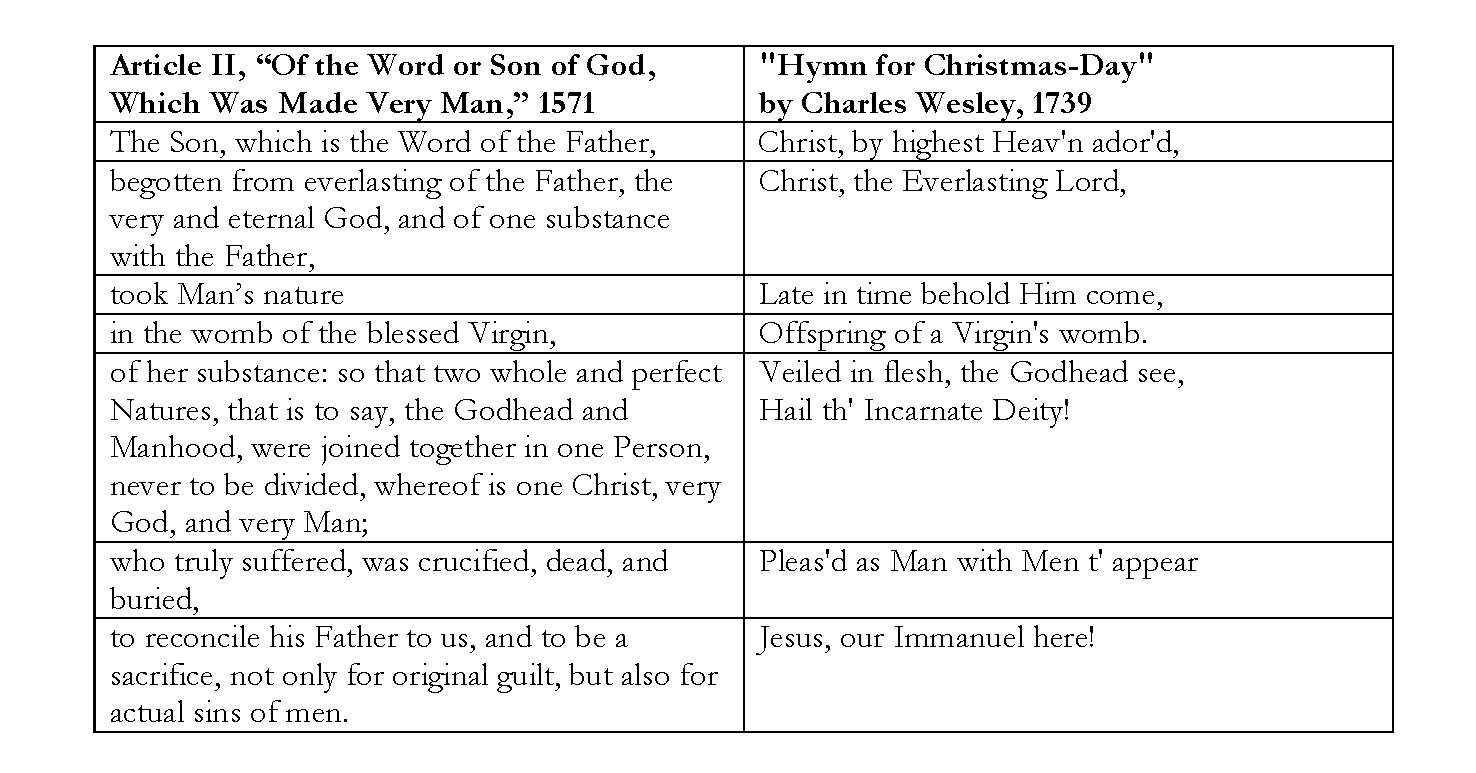
Charles Wesley is not often cited as an authoritative voice in Wesleyan theology outside his hymns, but his views on the Articles of Religion are well recorded. His hymns themselves contain direct language borrowed from the Articles. Most famously, his hymn ‘Hark! The Herald Angels Sing’ meticulously reflects the same Christological outline of Article II, ‘Of the Word or Son of God, Which Was Made Very Man.’
Likewise, in several of his sermons, he directly teaches from the Articles of Religion. Sermon 6, found in Newport’s critical edition, soundly condemns those who subscribe to the Articles of Religion without holding to the plain meaning. He calls them “infamous evaders… worse than the schismatics.” In the same sermon, he explains Article XVII ‘On Predestination’ is “purposefully so worded as to take in people of different sentiments, yet without giving the least sanction to the horrid doctrine and decree of reprobation.”4 In this statement, he articulates his complete subscription to the full Thirty-Nine Articles as compatible with his Arminianism. Canon law required an ex animo—meaning sincerely and from the heart—subscription to the Articles. Direct evidence such as this sermon, as well as Christian charity, requires we not assume Charles, nor John, should be thought to have their fingers crossed behind their backs in their subscription.
This invites us recall his family dynamics: Charles is the son of two originally nonconformist parents, both children of learned and defrocked nonconformist ministers. Charles, when ordained as a deacon and later priest, took vows of canonical obedience himself. It is no wonder he balked at those who would take those vows without the seriousness he personally knew they entailed. He knew of the consequences his grandfathers’ and great-grandfather faced as a result of their dissent. It is also no surprise he viewed his own theological convictions as perfectly compatible with the confession. Further, his belief that the Articles reject the “horrid decree… of reprobation” confirms the teaching of Article XVI, that “we may depart from grace given.” The Thirty-Nine Articles called both Calvinists and Arminians to a reasoned scriptural balance, affirming the doctrine of predestination alongside the possibility of apostasy.
John Wesley and the Articles of Religion
John Wesley took the same ex animo canonical vows as his brother. Several times in his sermons, writing, and treatises, he affirmed the doctrine of the Methodist societies was found in the doctrine of the Church of England, including the Thirty-Nine Articles. Like Charles, he taught from them in his sermons, for example in Sermon 74 ‘Of the Church.’ In his journal and letters, we find many entries where he defends himself against accusations that he or the Methodists did not ex animo subscribe to the Articles.
Early in the Methodist movement and at the outset of his field preaching, John would state his beliefs most clearly in his journal on September 13th, 1739.5
“A serious clergyman desired to know in what points we differed from the Church of England. I answered, ‘To the best of my knowledge, in none. The doctrines we preach are the doctrines of the Church of England; indeed, the fundamental doctrines of the Church, clearly laid down, both in her Prayers, Articles, and Homilies’.”
In a letter from December 30th, 1745, he responds to the accusation that he does not teach Predestination as outlined in Article XVII, echoing Charles’ sermon.6
“In saying, ‘I teach the doctrines of the Church of England,’ I do, and always did, mean… the doctrines which are comprised in those Articles and Homilies to which all the clergy of the Church of England solemnly profess to assent, and that in their plain, unforced, grammatical meaning.”
In a sermon later in his ministry on April 21st, 1777, he preached ‘On the Foundation of a Chapel’ (Sermon 132) and answered critics who were claiming the Methodists were a new sect with divergent beliefs from the Church of England.
“Methodism, so called, is the old religion, the religion of the Bible, the religion of the primitive Church, the religion of the Church of England…. as appears from all her authentic records, from the uniform tenor of her Liturgy, and from numberless passages in her Homilies.”
Earlier in the same sermon he says “the doctrine of the Church of England, as contained in her Articles and Homilies.” This undoubtedly demonstrates the “authentic records” positioned alongside the Homilies and Book of Common Prayer (her Liturgy) are the Articles of Religion.7 These three examples highlight his subscription to the Thirty-Nine Articles, and his expectation of Methodist doctrine to adhere to them, as his long standing belief from the earliest days of his Methodist societies to his later ministry.
John’s Abridgement
The most important part of John’s relationship with the Articles of Religion, however, is his purposeful abridgement of them from Thirty-Nine to Twenty-Four, which he published in 1784 alongside his commissioning of Coke to superintend the Methodists in North America.8 Other than the record that his close associate John Fletcher encouraged the task, requesting “39 rectified Articles,” we know little of the methodology of the project.9
The chief inquiry about the Methodist Articles is: ‘What exactly does the abridgement mean?’ Unfortunately, Wesley himself would not publish any justification for his abridgement before his death. The direct heirs of Wesley, such as Methodist systematican William Burt Pope, believed his abridgement was not an abrogation.
Paul F. Blankenship, in his article “The Significance of John Wesley's Abridgement of the Thirty-Nine Articles,” helpfully outlines three criteria in which the abridgement operates. First, there are deletions which are occasioned by the American Revolution and political realities. For example, the mentions of princes and English magistrates were inapplicable. Second, there are the deletions which may indicate doctrinal difference. What Blankenship then outlines is areas where Wesley was often defending his theology against critics who accused him of violating these Articles. The implication is not that he disagrees with these doctrines, but did not want disputation to unnecessarily obstruct the Methodists in America. The third criteria is edits for the sake of clarity and precision. This is essentially where Blakenship places the remaining edits where the aforementioned criteria do not clearly apply and we have no other reason for them except Wesley perceiving a clarity issue. Some evidence for this is the few Articles where Wesley retranslates words, revisiting the Latin version of the Articles and offering a small change, such as ‘traditions’ to ‘rites.’
Blankenship concludes that Wesley’s decision to conduct a mere abridgement instead of a revision was a statement in itself. He says, “A revision would have given a more complete picture of Wesley's doctrine and would have provided early as well as contemporary American Methodism with a more complete set of Articles. For instance, it would have been helpful to have Wesley's clear distinction between absolute and conditional predestination included in the Articles. However, he chose to make an abridgement rather than a revision.”10
Methodist Heirs and the Articles of Religion
To understand how faithful Methodists viewed the Articles of Religion post-Wesley, we will briefly consider three important heirs: William Burt Pope, Thomas C. Oden, and William J. Abraham. It is important that heirs are identified if confessionalism is to be properly inherited.
William Burt Pope and the Articles of Religion
William Burt Pope is one of the most significant theologians in Methodist history, and is routinely cited as her chief systematic theologian.
Pope’s extensive writing is useful to help us understand first what a confession is. In defining the difference between creeds and confessions, he says, “Generally speaking, the creeds were the authoritative statements of the faith in the ancient and undivided church; the confessions, or standards, or articles, or formularies, are those of the divided church in its individual communities.”11 This is an important distinction to understand. Creedal beliefs confirm us as mere Christian, confessions define us as particular Christian traditions. Why not prefer to have only creeds, then? Without confessions, it is hard to define with authority much about the Scriptures and Christian faith except who God is. And we have to define more because from these specific confessional beliefs flow our soteriology, social teaching, ethics, and basically every theological category.
Pope clarifies further, confessions are “that which represents the several views of Christian faith held by the divisions of Christendom since the sixteenth century: the dogmatic and polemical testimony and teaching of each communion, viewed in its relation to the others.”12 This definition is careful to speak of confessions as ‘polemical’ and ‘viewed in relation to the others.’ Confessions do not merely say who we are as Christians, but who we are as Presbyterians, Methodists, Lutherans, etc. If we are to be divided, we better have really good reasons why we believe our doctrines are more faithful to God’s Word than other traditions’ are. This does not mean confessions need to be endless, but they do clearly establish principles from which we do the work of theology within a tradition without departing from it. This justifies Wesley’s abridgement not necessarily being a step backwards when taken alongside his Sermons, Notes, and General Rules.
Additionally, Pope’s utilization of the Articles in his systematic writings is particularly noteworthy. For one, he takes them seriously as a doctrinal standard. He also claims direct succession with John Wesley in holding not merely to the Twenty-Five Articles but to the entire English Thirty-Nine Articles of Religion. He claims this is an expression of the full reception of doctrine for the Methodists.
“Methodist theology, which has spread during the last century over a very wide area of Christendom, is Catholic in the best sense, holding the Doctrinal Articles of the English Church, including the Three Creeds, and therefore maintaining the general doctrine of the Reformation. It is Arminian as opposed to Calvinism, but in no other sense. Its peculiarities are many, touching chiefly the nature and extent of personal salvation; and with regard to these its standards are certain writings of John Wesley and other authoritative documents.” — A Compendium of Christian Theology
In particular, Pope concentrates on what Methodism has received and inherited as an authoritative canon of doctrine. A canon is the rule, an agreed upon authoritative body of works, like the 27 books that make up the New Testament canon. Pope does not seek new formulations for Methodism’s doctrinal canons. He says:
“Methodism has issued no formal and general confession. It holds for the most part the three creeds, and the doctrinal formulary of the English Church [the Thirty-Nine Articles]; but its standards are found more particularly in certain writings of the Founder of the Society. American Methodism aims at a more distinct confession.” — A Higher Catechism of Theology
In essence, he contends Methodism does not, in his day, require confessions that are unique to herself. Instead, she has received sufficient confessions from the English Church, which is the Thirty-Nine Articles, the three creeds, and the writings of “the Founder”—John Wesley. For Pope, Methodism not issuing its own confession matters naught because what it has inherited is Catholic, Reformed, and sufficient for the confessional task of doctrine.
Notably, he does not merely apply this principle of reception to the Articles, but applies the principle to the creeds as well. Notice in the quote from Compendium above Pope speaks of the “three creeds,” that third being the Athanasian Creed which is glaringly absent from the GMC’s Doctrinal Standards.13 Yet, its presence in Article VIII of the Thirty-Nine Articles provides it to Pope as Methodism’s own, therefore he magisterially cites it as part of the authoritative canon he has received. American Methodist systematician Thomas O. Summers also considers the Athanasian Creed as part of the Methodist inheritance.14
The Next Methodism and the Articles of Religion
Few modern voices were as impactful in Methodism as were the voices of Thomas C. Oden and William J. Abraham as they worked for renewal within Methodism and laid much foundation for the GMC. They also represent two perspectives on the Articles of Religion which are worth briefly exploring, as they more directly influence the present conversation while clearly expressing continuity with W.B. Pope.
Beginning with Oden, his book Doctrinal Standards in the Wesleyan Tradition contends that the Articles of Religion are part of the ‘Conciliar Formulae’ of Methodism. He quotes Nathaniel Burwash, who says, “They indicate that which we have received as our common heritage from the great principles of the Protestant Reformation, and from the still more ancient conflicts with error in the days of Augustine and Athanasius.”15 The language of ‘common heritage’ and ‘the great principles of the Protestant Reformation’ is significant. This indicates it is not merely about saying the right things, but being in continuity with those who have walked before us in the same faith. It is also important he notes a fundamental feature of the Articles is their rejection of specific errors.
Oden also outlines six ways doctrinal standards function within the church. To highlight the third way, he says, “They serve as a trustworthy source by which the truth is attested to and received.” The principle of reception (inheritance) ought to not be divorced from confessionalism because Christians do not operate in a solitary faith, but exist within the Church, receiving the “the faith that was once for all delivered to the saints” that St. Jude commands us to “fight” for (Jude 1:3)!
Abraham, in his chapter in The Next Methodism, makes a similar argument from a place of canonicity. Anticipating the question of ‘Why must Methodists retain the Articles?,’ he answers twofold: “First, they reiterate our commitment to the classical faith of the church and, second, they identify those elements of the Reformation and the evangelical awakenings that are pivotal for our intellectual and spiritual welfare.”
Departing from Pope and Oden, Abraham articulates one manner in which he believes the Articles need change. He says, “We need, of course, to excise the relevant anti-Catholic material but, otherwise, the case for the Articles and Confession is secure.”16 He does not qualify this statement or expand on it, but it is important to note he is a source of the desire to reform the Articles in this way without speaking in favor of the synthesis rewrite that is presently being undertaken. You can see his suggestion being adapted in principle through the GMC’s Proposed Articles of Faith which do not contain any apophatic articles and go as far as to comment such aspects of the Articles of Religion are “irrelevant.”17
Blankenship, earlier mentioned concerning his scholarly work on Wesley’s abridgement, also contends the Articles must change. Interestingly, he does not argue for a replacement document such as the GMC is undertaking, or more deletions such as Abraham proposed. Instead, he suggests they need to be extended “until they constitute the revision of the Thirty-Nine Articles that Wesley chose not to make.”18 This is an interesting proposition which leads us into a discussion of new confessions.
New Confessions
I have aimed to demonstrate that, historically speaking, Methodism was not intended to have its own unique confession that displaces the Articles and supersedes them. Rather, as purposely designed by John Wesley, Methodism was originally intended to have confessional reception. William Burt Pope understood and applied this principle better than anyone else. He was unafraid to authoritatively appeal to the fuller Thirty-Nine Articles as needed, saying for example of the Article ‘Of the Sacraments,’ one of the articles abridged by John Wesley (XVI in the Twenty-Five and XXV in the Thirty-Nine), “The definition in the English Article strikes the true note.”19
I believe it is well established in Christian tradition that new confessions can and should be articulated when the need arises. Recall Pope’s definition of a confession. The two great periods of Catholic creedalism in the first five centuries and Protestant confessionalism in the 16th and 17th centuries were marked up and down with creeds and confessions. The demands of the time necessitated their writing. Heresies were in need of condemnation, and distinctives in need of articulation. The several Reformed confessions often interacted and built off one another, such as the heavy influence of the Augsburg Confession on the Thirty-Nine Articles of Religion.
A Humble Note of Concern for the Global Methodist Church
I wonder if the GMC’s Proposed Articles of Faith take the historical perspective of confessionalism fully into account. For example, in the Global Anglican Communion and Anglican Church in North America to which I belong, we recently articulated the Jerusalem Declaration in 2008. It functions as a confession, but does not replace or supersede the inherited formularies. Instead, it binds us even more rigidly to them, affirming, “We uphold the Thirty-nine Articles as containing the true doctrine of the Church agreeing with God’s Word and as authoritative for Anglicans today.”20 It then proceeds to confessionally declare things the Church determined were necessary to articulate in a new confession in this age about anthropology, marriage, jurisdiction, and more. The Jerusalem Declaration takes Anglican confessional reception seriously.
Reception is also a much simpler method of doing confessionalism than synthesizing, which, no matter how you slice it, is actually articulating a new confession to replace the old at the end of the day. New language will be used. Old language will be discarded. New and unforeseen problems will be created. The direct connection to the historical formulations, with their centuries of standard interpretations, precedents, and commentaries, will slowly be relegated to an even more forgotten and inaccessible state than they already are. A new canon of interpretation will need to be crafted around the new confession, which will take decades to begin to flesh out. Modernisms will be unavoidable in the process. This is why I so strongly contend that confessional reception and confessional synthesization are two distinct and even opposed ways of doing confessionalism. The latter will inevitably be something new with many unavoidable complexities and losses.
Thomas O. Summers wrote critically of changes to the Articles in his day among offshoot denominations, saying, “Some of the minor Methodist bodies have attempted to improve the Confession by both omissions and additions; but their experiments are not encouraging. The Confession is, of course, susceptible of improvement; but there is great advantage in settled formulæ. ‘Meddle not with them that are given to change’.”21
Reception is a fundamentally more faithful principle, and is inherent to the principles of Methodism itself (see: Wesley’s sermon 132, ‘On Laying The Foundation Of The New Chapel,’ esp. II.1-5). W.B. Pope once instructed students, “If you are beginning your course of Methodist theological instruction, do not descend to the moderns until you have imbued your mind with the teaching of our standard writings.”22 My concern is not that a new confession is being written, as I said, they should when the need arises. Rather, I am concerned that, in the GMC’s case, a replacement confession is being written which at worst abrogates and at best confuses the confessional and doctrinal inheritance the Methodists have providentially received from the primitive church, the Protestant Reformation, and most directly from John Wesley himself.
“In religion I am for as few innovations as possible.”
- John Wesley
As I said at the beginning, I have no dog in the fight about the language of the GMC’s Proposed Articles of Faith, the revision process, polity, or anything like that, and don’t feel a need to wade into it. For what it’s worth, I do not think the adoption of the new confession will make or break the GMC, but its adoption could be a choice to fundamentally reject direct confessional reception in its canon of doctrine, which will have a wide ranging impact on how theology is done in the Methodist tradition for a very long time to come.
As one trying to live peaceably as a student of Original Methodism within the Anglican tradition and who subscribes to the Thirty-Nine Articles, I hope others, especially my brothers in the GMC, will choose to take up the shield of reception and sword of inheritance. To do so is not merely to keep the received Articles on paper, but also requires intentionality to truly receive the faith once delivered to all the saints in a manner that fosters true belief and holiness of heart and life.
Let us pray:
Gracious Father, we pray for your holy Catholic Church. Fill it with all truth, in all truth with all peace. Where it is corrupt, purify it; where it is in error, direct it; where in anything it is amiss, reform it. Where it is right, strengthen it; where it is in want, provide for it; where it is divided, reunite it; for the sake of Jesus Christ your Son our Savior. Amen.23
Petition 115, found in the “Pre-Conference Final Petitions Report,” Journal of the Global Methodist General Conference (2024).
If you are interested in contemporary perspectives, I highly recommend the panels being hosted by my friend Jeffery Rickman on the PlainSpoken podcast. The first panel can be found here.
J.R. Watson, “Charles Wesley and the Thirty-Nine Articles of the Church of England,” in Proceedings of the Charles Wesley Society, vol. 9 (2003-2004), 29-30.
“Sermon 6” in Charles Wesley, The Sermons of Charles Wesley, ed. Kenneth G. C. Newport, Oxford University Press (2001), 177-178. Earlier in the same sermon, Charles quotes three Articles verbatim, XI-XIII: C. Wesley, Sermons, 176-177.
John Wesley, The Journal of the Rev. John Wesley, ed. Nehemiah Curnock. Vol. 2. (1909–1916), 274-275.
John Wesley, “Dec 30, 1745” in The Letters of John Wesley, Wesley Center for Applied Theology. https://wesley.nnu.edu/john-wesley/the-letters-of-john-wesley/wesleys-letters-1745/
John Wesley, “On Laying The Foundation Of The New Chapel, Near The City-Road, London” in The Sermons of John Wesley (1872), Wesley Center for Applied Theology. https://wesley.nnu.edu/john-wesley/the-sermons-of-john-wesley-1872-edition/sermon-132-on-laying-the-foundation-of-the-new-chapel-near-the-city-road-london/
Article XXIII was added by the MEC General Conference. It is substantially equivalent in purpose with Article XXXVII in the Thirty-Nine Articles. The Episcopal Church adapted a similar revised version of Article XXXVII for the American context in 1801.
Wesley, Journal, Vol. 8 (1916), 333.
Paul F. Blankenship, “The Significance of John Wesley's Abridgement of the Thirty-Nine Articles ·As Seen From His Deletions” in Methodist History 2, 3 (1965), 45.
William Burt Pope, A Higher Catechism of Theology, T. Woolmer (1885), 7.
Pope, Higher Catechism, 8.
There is a myth perpetrated in Wesleyan academia that John Wesley was opposed to the Athanasian or even Nicene Creed. In Sermon 55, ‘On the Trinity,’ John clearly affirms the Athanasian Creed, as well as in his journal in December of 1760. Responding to the accusation that he has falsified the Athanasian Creed’s first article, he says, “But how so? Why, I said ‘The fundamental doctrine of the people called Methodists is, whosoever will be saved before all things it is necessary that he hold the true faith’.”
Thomas O. Summers, Systematic Theology: A Complete Body of Wesleyan Arminian Divinity Consisting of Lectures on the Twenty-Five Articles of Religion, Vol. I, Publishing House of the Methodist Episcopal Church, South (1888), 34-35.
Thomas C. Oden, Doctrinal Standards in the Wesleyan Tradition, Abingdon Press (2008), 18.
William J. Abraham, “The Next Methodism: Doctrine or Death,” Seedbed; Jan 25, 2022. https://seedbed.com/the-next-methodism-doctrine-or-death/
The Proposed Articles of Faith of the Global Methodist Church; Discipleship, Doctrine, and Just Ministry Commission (2025), 7-8.
Blankenship, “John Wesley’s Abridgement,” 12.
William Burt Pope, A Compendium of Christian Theology: Being Analytical Outlines of a Course of Theological Study, Biblical, Dogmatic, Historical; Vol. 3, Beveridge and Co. (1879), 306.
Article 4 of the Jerusalem Declaration, 2019 BCP, 792.
Summers, Systematic Theology, Vol. I, 41.
William Burt Pope, “The Peculiarities of Methodist Doctrine,” Holy Joys. https://holyjoys.org/peculiarities-methodist-doctrine/
William Laud, “Prayer For the Universal Church,” 2019 BCP, 646.
Thank you for this article!!! I am Global Methodist and I am 1,000% against the new Articles of Faith! By abolishing the 25 Articles we GMC folks are severing our connection from our own Methodist history, the Church of England and the Protestant Reformation! We are making a terrible mistake....
The importance of the 39 articles in comprehending orthodox Christianity in the English language cannot be understated. I genuinely appreciate the historical lineage you have documented here, and hold that it is imperative that Methodism retains its Anglican identity.